
The "Lightning Bolt" Pain: 3 Ways to Ease Sciatica at Home (And When to Call a Professional)
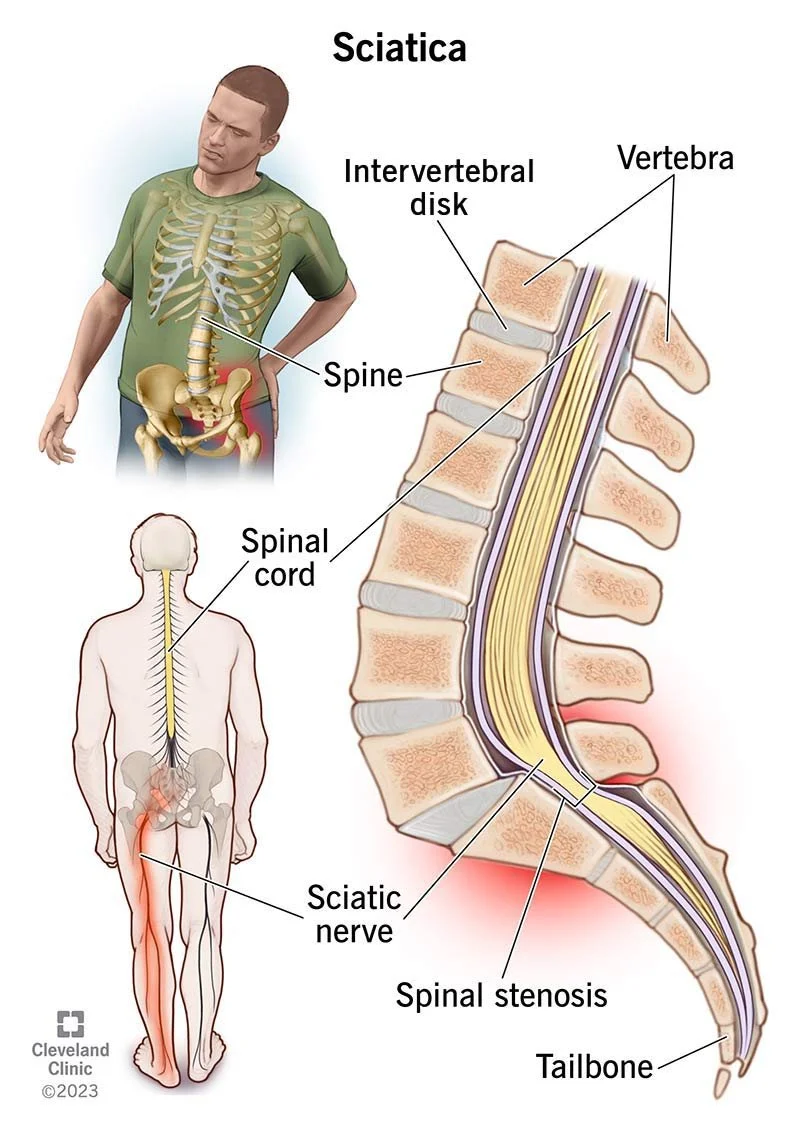
Cause of Sciatica
If you’ve ever felt a sharp, shooting pain that starts in your lower back and travels down your leg like a bolt of lightning, you’ve met Sciatica.
For many of our clients at Balanced Pro Massage, sciatica isn't just a physical pain—it’s a lifestyle disruptor. It makes driving the Southern California freeways miserable and sitting at an office desk unbearable. Before you pick up the phone to book a session, there are a few things you can do right now to lower the "volume" of that pain and understand exactly what is happening in your body.
Sciatica vs. Piriformis Syndrome: Which One Is It?
Before treating the pain, it helps to understand the source. While both conditions cause "shooting" sensations, they are not the same. True Sciatica is usually a spinal issue, where a bulging or herniated disc in your lower back pinches the nerve at the root.
Piriformis Syndrome, however, is a muscular issue. The sciatic nerve runs directly underneath (or sometimes through) the piriformis muscle in your glute. If that muscle spasms from too much sitting or repetitive strain, it "chokes" the nerve.
The simple rule of thumb: If you have back pain and leg pain, it’s likely true sciatica. If your back feels fine but your hip is tender and your leg is tingling, you're likely dealing with Piriformis Syndrome.
1. The "First Aid" Stretch: The Reclined Pigeon
If your pain is caused by the piriformis muscle, you need to give that nerve some breathing room:
Lie on your back with your knees bent.
Cross your right ankle over your left knee.
Gently pull your left thigh toward your chest.
The Goal: You should feel a deep stretch in the hip, not a sharp pain. Hold for 30 seconds.
2. Ice vs. Heat: Know the Difference
In the first 48 hours of a "flare-up," Ice is your best friend. It reduces the inflammation that is physically pressing on the nerve. After the initial sharpness fades (usually after two days), switch to Heat to relax the muscles that have tightened up in "protection mode."
3. Decompress Your Spine
If the issue is spinal, gravity is often the enemy. To decompress:
Place your hands on a sturdy kitchen counter and lean forward.
Let your lower body hang heavy, allowing your vertebrae to gently pull apart.
This "micro-decompression" can sometimes create just enough space to stop the nerve from firing.
Professional Assessment: Getting to the Root Cause
Self-care is vital, but it has its limits. If you’ve been stretching for several days and the pain is still "stuck," it’s time for clinical intervention. When I arrive for a mobile session, we don’t just start massaging; we use orthopedic "provocative tests" to pinpoint the source of the impingement:
The Straight Leg Raise: While you lie flat, I slowly lift the leg. If sharp pain occurs at a specific angle (usually between 30 and 70 degrees), it typically indicates a spinal disc issue.
The FAIR Test: By moving the hip into a specific position of Flexion, Adduction, and Internal Rotation, we put the piriformis muscle on a maximum stretch. If this recreates your symptoms, it’s a clear sign the muscle is the culprit.
This distinction is vital. A disc issue requires gentle decompression and careful positioning, while Piriformis Syndrome responds beautifully to targeted myofascial release and trigger point therapy.
The Balanced Pro massage Advantage
When nerve pain hits, the last thing you want to do is sit in a car for 30 minutes to get to a clinic—that sitting position often makes the compression worse. Our mobile service brings 30+ years of therapeutic expertise directly to your door, allowing you to receive professional care and then return immediately to resting in your own home.
We Proudly Provide Mobile Massage to the Following Cities:
Stop "managing" the pain and start moving again.